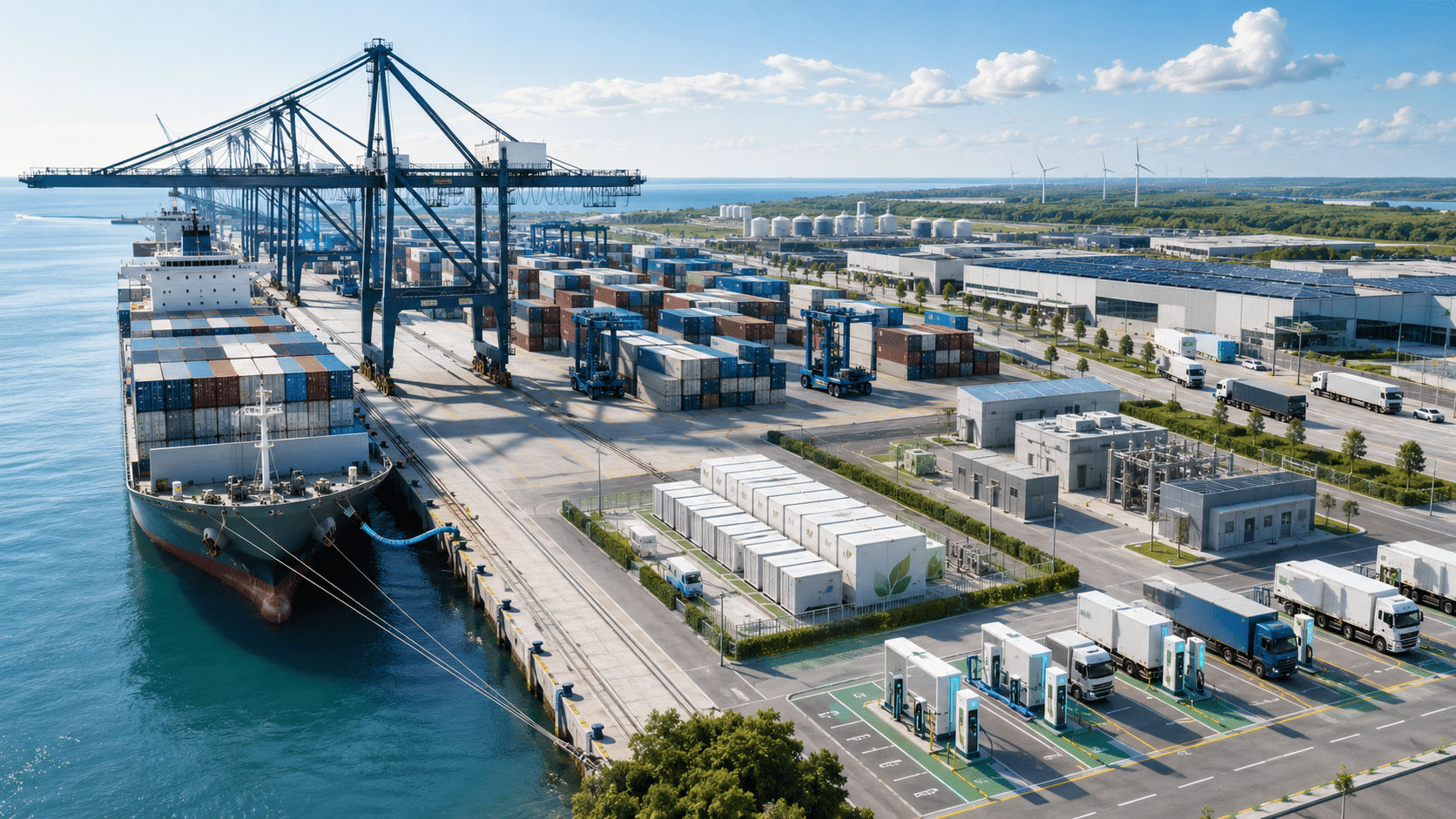



Ports already understand that electrification will increase demand for power. The more important question now is what they do with that capability once they have it.
As transport, cargo handling and industrial operations electrify – and automation increases their dependence on reliable energy – customers will need more than access to electricity. They will need charging, managed power, resilience and energy services that fit around their operations.
That creates a commercial opportunity for ports.
The next phase of port electrification is not simply about securing more megawatts. It is about deciding how to turn power into value for customers.
The conversation has moved on from simply needing more power
Grid capacity remains a constraint for many ports. New connections can be slow and expensive, while the electrification of vessels, trucks, terminal equipment, warehouses and industrial operations will increase demand.
But that challenge is well understood.
The question for port leaders is now different:
Will power remain an infrastructure input, or become part of the port’s offer to customers?
- A haulier does not ultimately want electricity. It wants trucks charged at the right time, at a predictable cost, without disrupting operations.
- A terminal operator wants reliable power for increasingly electrified and automated equipment.
- A tenant wants capacity, resilience and visibility over energy costs.
As those requirements grow, the opportunity moves beyond providing power towards providing power services.
Leading ports are already moving in this direction.
ABP is exploring how its port infrastructure, land and commercial ecosystem can create greater value for existing and future customers, while renewable generation across its estate already supports both its own operations and customers.
At DP World Southampton, elements of electrification are becoming more directly customer-facing, from electric-HGV charging and trials to services that allow customers to benefit from emissions reductions achieved through port operations.
Rotterdam is developing ways to optimise and exchange energy between businesses in its industrial cluster.
Individually, these initiatives address different needs. Together, they point to a bigger shift: from ports simply providing power infrastructure to managing a wider range of services built around power.
Capturing that opportunity requires three decisions.
Decide what electrification means for your customers
The first decision is commercial.
Does the port simply want to make enough power available, or use electrification to strengthen what it offers customers?
Those are different choices.
At one end, the port provides access to electricity and the customer manages everything beyond it.
At the other, the port provides a service: making sure vehicles, equipment or facilities have the power they need, when they need it, at an understood cost. Charging infrastructure, managed charging, billing, optimisation, storage and generation can all sit behind that service.
Not every port needs to offer everything.
And the opportunity does not necessarily lie in simply putting a margin on the electricity itself. Regulation, market structures and individual supply arrangements will shape what ports can charge for power.
The greater opportunity may lie in the services around it – charging, availability, management, optimisation and resilience – brought together as part of the port’s offer.
Customers will increasingly judge locations partly on how easily and economically they can electrify their operations.
That makes power capability a potential source of competitive advantage, particularly where ports face similar grid constraints but differ in how well they manage them.
For commercial teams, the question is therefore not simply “how much power do our customers need?” but “what do they need us to enable?”
Decide what platform will manage the electrified port
More electrification also creates more complexity.
A large port may need to coordinate chargers, batteries, on-site generation, grid connections, meters, contracts and pricing across tenants, hauliers, vessels and its own operations.
At the same time, demand will become more dynamic as cargo-handling equipment, trucks, autonomous systems and warehouses compete for available capacity.
Physical infrastructure makes electrification possible.
The digital platform makes it manageable – and commercial.
A smart power-management platform can provide a common view across assets and customers: when energy is being used, where capacity is available, what charging needs to happen when, and how generation or storage can reduce peaks and costs.
It can also support customer services, from charging access and billing to managed energy and different levels of service.
Without that common platform, ports risk solving each requirement separately.
Different operators install different chargers. Tenants procure their own systems. Storage, generation and charging are managed independently.
The result is fragmentation: less visibility, less control and potentially higher infrastructure and operating costs.
The technology decision is therefore no longer simply which chargers or energy assets should we install?
It is:
What platform do we need to manage an increasingly electrified port?
Decide what to own and where to partner
The third decision is about investment and capability.
Ports do not need to build every element themselves.
Charging infrastructure, software, batteries, renewable generation and energy services can all involve specialist providers. The key is deciding which capabilities the port needs to control and which can be delivered through partners.
That means deciding who should fund, own and operate the infrastructure, who manages the customer relationship, and where the commercial value should sit.
DP World’s approach at London Gateway illustrates one model. As it electrifies its straddle-carrier fleet, the port has partnered with specialist providers for high-power charging technology and charging management.
The point is not that ports need to build every capability themselves. It is that they need to decide what they should own, what they should control and where specialist partners can help them move faster.
For CFOs and commercial leaders, this is as much an investment decision as a technology one.
The aim is not to own everything. It is to keep enough control over the customer offer, data and how the service is run to benefit commercially from electrification.
From power infrastructure to power services
Ports have spent years discussing where the power required for electrification will come from. That question has not disappeared.
But it is no longer the only question that matters.
Electrification is changing what customers will need from ports — and therefore what ports have the opportunity to provide.
The ports that treat power solely as an infrastructure requirement risk absorbing much of the cost of the transition.
Those that build the capability to manage it, optimise it and turn it into services can use electrification to strengthen their offer to customers and improve their competitive position.
The next phase of port electrification is not about making the case for more power. It is about deciding how to turn power into value for customers.
How VEV can help
For CFOs, Commercial Directors, CIOs, CTOs and Power Directors, the question is no longer just how much power the port needs. It is what capability is needed to manage it – and create value from it.
VEV helps ports turn electrification into a managed commercial capability.
We work with port teams to define where to start, what to own, where to partner and how electrification can support both operations and the customer offer.
VEV IQ provides the digital platform to manage charging, power demand, assets and energy services across increasingly complex port operations, giving teams the visibility and control they need as electrification grows.
If you are considering how electrification should fit into your port’s future offer, VEV can help you define the opportunity and the platform capability needed to support it.